
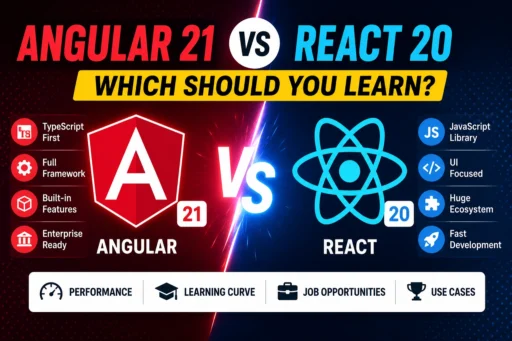
Choosing the right frontend framework can significantly impact your career as a web developer. Two of the most popular choices in 2026 are Angular 21 and React 20.
Both technologies are widely used by startups and enterprise companies, but they differ in architecture, learning curve, performance, scalability, and ecosystem.
If you’re a beginner or planning to switch frameworks, this guide will help you decide which one is the best fit for your goals.
What is Angular 21?
Angular 21 is the latest version of Google’s frontend framework designed for building scalable, enterprise-level web applications.
Angular provides almost everything developers need out of the box, including:
- Routing
- Dependency Injection
- HTTP Client
- Reactive Forms
- Signals
- Server-Side Rendering (SSR)
- TypeScript Support
- Built-in Testing Tools
Angular follows a complete framework approach, making it ideal for large applications.
What is React 20?
React 20 is the latest version of Meta’s JavaScript library for building user interfaces.
Unlike Angular, React focuses only on the UI layer. Developers typically use additional libraries for routing, state management, forms, and API calls.
Popular React libraries include:
- React Router
- Redux Toolkit
- Zustand
- TanStack Query
- React Hook Form
- Next.js
React offers greater flexibility but requires more decisions during development.
Angular 21 vs React 20: Quick Comparison
| Feature | Angular 21 | React 20 |
|---|---|---|
| Developed By | Meta | |
| Type | Full Framework | UI Library |
| Language | TypeScript | JavaScript / TypeScript |
| Learning Curve | Moderate | Easy to Moderate |
| State Management | Signals, RxJS | Hooks, Context API, Redux |
| Routing | Built-in | React Router |
| Forms | Built-in | Third-party libraries |
| Dependency Injection | Yes | No |
| SSR | Angular SSR | Next.js |
| Best For | Enterprise Apps | Startups, SPAs |
Learning Curve
Angular 21
Angular has a steeper learning curve because developers need to understand:
- Components
- Modules
- Services
- Dependency Injection
- RxJS
- Signals
- Directives
- Pipes
However, once learned, Angular provides a consistent development experience.
React 20
React is generally easier for beginners.
You mainly need to learn:
- JSX
- Components
- Props
- State
- Hooks
You can start building applications much faster.
Winner: React 20
Performance Comparison
Both frameworks offer excellent performance.
Angular 21
Angular has significantly improved performance with:
- Signals
- Better hydration
- Incremental rendering
- Faster change detection
These improvements reduce unnecessary DOM updates.
React 20
React provides excellent performance through:
- Virtual DOM
- Automatic batching
- Concurrent rendering
- React Compiler optimizations
For most applications, users won’t notice a significant performance difference.
Winner: Tie
Code Comparison
Angular 21 Counter
import { Component, signal } from '@angular/core';

@Component({
  selector: 'app-counter',
  template: `
    <h2>{{ count() }}</h2>
    <button (click)="increment()">Increment</button>
  `
})
export class CounterComponent {

  count = signal(0);

  increment() {
    this.count.update(value => value + 1);
  }

}
React 20 Counter
import { useState } from 'react';

function Counter() {

  const [count, setCount] = useState(0);

  return (
    <>
      <h2>{count}</h2>

      <button
        onClick={() => setCount(count + 1)}
      >
        Increment
      </button>
    </>
  );
}

export default Counter;
Both implementations are clean and easy to understand.
State Management
Angular 21
Angular offers multiple options:
- Signals
- RxJS
- NgRx
- Signal Store
Signals make local state management much simpler than before.
React 20
React provides:
- useState
- useReducer
- Context API
- Redux Toolkit
- Zustand
- MobX
Developers have more freedom to choose.
Winner: Tie
Development Speed
Angular
Angular projects require more initial setup but become easier to maintain as they grow.
React
React allows developers to build prototypes and MVPs much faster because it has fewer built-in rules.
Winner: React
Enterprise Development
Angular is used by many enterprise organizations because it provides:
- Strong project structure
- Dependency Injection
- Built-in testing
- Long-term support
- TypeScript-first development
Large teams often prefer Angular for consistency.
Winner: Angular
Community and Ecosystem
Angular
- Strong Google support
- Stable release cycle
- Excellent documentation
- Growing Signals ecosystem
React
- Massive community
- Huge npm ecosystem
- Thousands of third-party libraries
- Extensive learning resources
Winner: React
Job Opportunities
Both Angular and React offer excellent career opportunities.
Angular Jobs
Common roles include:
- Angular Developer
- Frontend Developer
- Full Stack Developer
- Enterprise Application Developer
Angular is widely used in finance, healthcare, government, and enterprise software.
React Jobs
React dominates many startup and product-based companies.
Common roles include:
- React Developer
- Frontend Engineer
- UI Developer
- Full Stack JavaScript Developer
React generally has a larger number of job postings globally.
Which Framework Should Beginners Learn?
Choose Angular 21 if you:
- Prefer structured development
- Enjoy TypeScript
- Want to build enterprise applications
- Plan to work in large organizations
Choose React 20 if you:
- Want a faster learning curve
- Like flexibility
- Want to build startups or personal projects
- Enjoy choosing your own tools
Pros and Cons
Angular 21
Pros
- Complete framework
- Excellent architecture
- Built-in routing
- Built-in forms
- Dependency Injection
- Strong TypeScript support
- Great for enterprise projects
Cons
- Steeper learning curve
- Larger bundle size
- More concepts to learn
React 20
Pros
- Easy to learn
- Huge community
- Flexible architecture
- Large ecosystem
- Excellent performance
Cons
- Requires many third-party libraries
- Multiple ways to solve the same problem
- More architectural decisions
Frequently Asked Questions
Is Angular better than React?
Neither is universally better. Angular is ideal for structured enterprise applications, while React is excellent for flexible UI development and startups.
Is Angular 21 faster than React 20?
Both provide excellent performance. Angular has improved significantly with Signals and hydration, while React continues to optimize rendering performance.
Which framework has more jobs?
React generally has more job opportunities worldwide, but Angular remains highly demanded in enterprise environments.
Can I learn both?
Yes. Learning one framework makes it much easier to understand the other because both use component-based development.
Which framework is better for large applications?
Angular is often preferred for large enterprise applications due to its built-in architecture and conventions.
Conclusion
Both Angular 21 and React 20 are outstanding technologies, and choosing between them depends on your career goals and project requirements.
If you enjoy structured development, TypeScript, and enterprise-grade applications, Angular 21 is an excellent choice.
If you prefer flexibility, rapid development, and a vast ecosystem, React 20 is hard to beat.
Ultimately, mastering either framework will open doors to exciting frontend development opportunities. For many developers, learning both over time provides the greatest flexibility in the job market.