
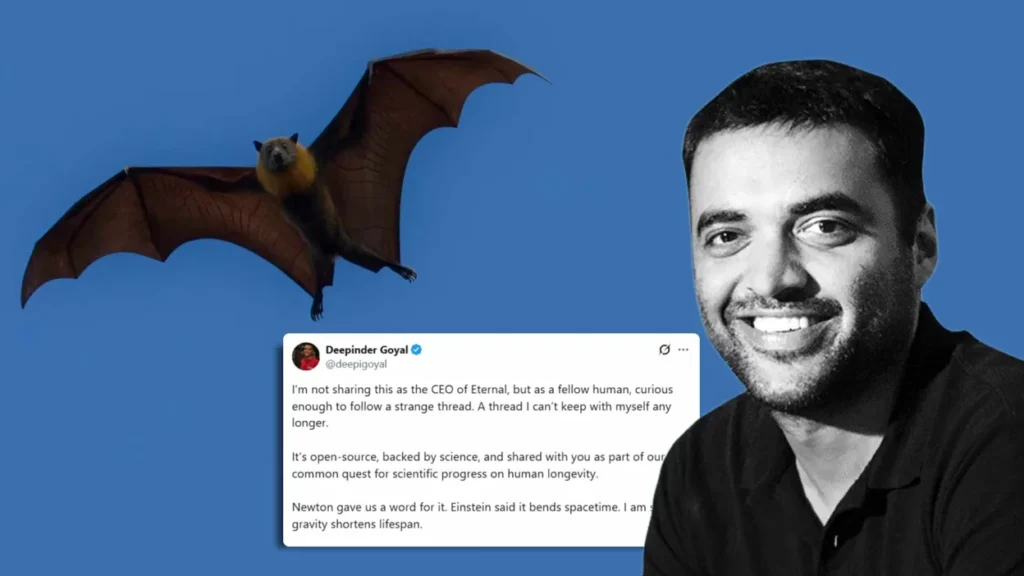
A bold hypothesis from Zomato CEO Deepinder Goyal has stirred up the scientific and medical community: he suggests that gravity might be a key driver of human ageing. But not everyone’s buying it. In a highly public rebuttal, Dr. Cyriac Abby Philips, better known online as The Liver Doc, has sharply criticized Goyal’s “Gravitational Theory of Ageing,” calling it “reductionist” and “mono-causal.”
This debate is more than just a clash of ideas — it’s a window into how we understand ageing, and what happens when high-profile entrepreneurs wade into complex scientific territory.
What is the “Gravity Ageing Hypothesis”?
Goyal’s theory — shared in a thread on X (formerly Twitter) — rests on three major observations:
- Upright posture over decades slightly reduces blood flow to the brain.
- Certain brain regions (like the hypothalamus and brainstem) are especially sensitive to small blood flow changes.
- Those same regions regulate many aging-related processes, such as hormones, inflammation, repair, and metabolism.
Goyal argues that over a lifetime, gravity’s constant pull could gradually impair cerebral blood flow, potentially accelerating the ageing process. He even suggests a countermeasure: daily sessions on inversion tables to tilt the body and increase brain blood flow.
Why The Liver Doc is Not Impressed
Dr. Philips has fired back publicly, saying Goyal’s idea “does not withstand even basic scientific scrutiny.” Here are his main criticisms:
- He calls the hypothesis reductionist and mono-causal — in other words, it oversimplifies ageing by attributing too much to just one factor (gravity), ignoring decades of multi-factorial aging research.
- According to him, Goyal commits a category error by treating gravity (a physical force) as if it’s the biological mechanism of ageing.
- He argues that much of Goyal’s supporting evidence (like data from astronauts, bat longevity, or correlations with height) stems from misinterpreted data, spurious associations, and logical fallacies.
- Philips points out that well-established scientific research shows ageing is multifactorial — with genetic, molecular, cellular, and environmental drivers.
- He urges Goyal to focus resources on proven mechanisms of ageing: genomic instability, telomere attrition, epigenetics, protein homeostasis, etc., rather than speculative gravity-based ideas.
- Moreover, Philips cautions that Goyal’s hypothesis might be leveraged into a business proposition — perhaps a device — to “exploit vague areas in science … and sell it to gullible people who want to live forever.”
What Other Experts Say
The Liver Doc isn’t alone in skepticism. Other neurologists and medical professionals have raised additional scientific concerns:
- Dr. Vinit Suri, senior neurologist at Apollo Hospitals, argues the brain has a powerful self-regulating system called autoregulation, which maintains steady blood flow even when posture changes.
- He also points out that astronaut data doesn’t support Goyal’s claims: in microgravity, astronauts do not show slowed ageing; instead, they suffer muscle and bone loss, among other problems.
- According to Suri, if gravity were truly the main driver of aging, then people lying down for long periods (or those living at high altitudes) should age more slowly — but that’s not borne out by reality.
- He emphasizes that known, controllable lifestyle factors — exercise, sleep, diet, cognitive engagement — remain far more impactful for brain health than any gravity-based intervention.

Bigger Picture: Science, Influence, and Responsibility
This exchange raises a few important questions:
- When should business leaders propose scientific hypotheses?
Goyal frames his theory as open-source and exploratory, not yet proven. But with his platform and financial resources, public speculation can have outsized influence — especially in fields like longevity that attract hope and investment. - What is the risk of overselling speculative science?
As The Liver Doc warns, speculative theory without rigorous testing can mislead people, especially when tied to potentially marketable interventions (like inversion devices). - Why do established mechanisms of ageing still matter?
Research into cellular damage, genetics, metabolism, and other “hallmarks of ageing” has decades of robust data behind it. These mechanisms aren’t glamorous, but they are proven and actionable.
Deepinder Goyal’s “Gravitational Theory of Ageing” is bold, provocative, and gaining attention. But boldness doesn’t guarantee scientific soundness. According to The Liver Doc and other experts, it oversimplifies a deeply complex biological problem and risks diverting time, money, and public attention from more credible longevity research.
If we genuinely want to live longer — and healthier — the smarter bet is not on speculative hacks, but on rigorous science, tested interventions, and proven lifestyle strategies.