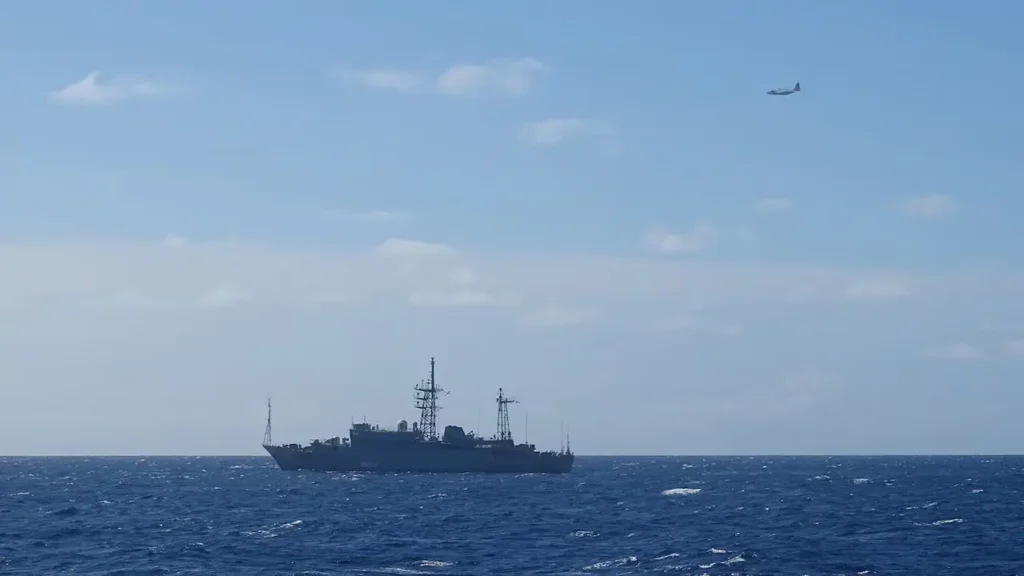
On October 29, 2025, the U.S. Coast Guard detected a Russian Navy auxiliary general intelligence ship, the Kareliya (a Vishnya-class intelligence vessel), operating approximately 15 nautical miles south of Oʻahu, Hawaii. While the ship remained outside the 12-nautical-mile boundary of U.S. territorial waters, its proximity to a key U.S. military and strategic region has raised questions about intent, norms, and maritime security.
In this post, we’ll examine:
- What international law permits in such situations
- Why the proximity matters
- What it might signal from Russia’s perspective
- What the U.S. response tells us
- Why readers should care
What International Law Permits
Under customary international law, sovereign territorial seas extend up to 12 nautical miles from a coast. Beyond that is international waters (or the Exclusive Economic Zone for certain rights, though not full sovereignty).
The U.S. Coast Guard has stated that foreign military vessels are permitted to transit and operate outside another state’s territorial sea, so long as they remain outside that 12-mile boundary. USCG News+1
In this case, the Kareliya remained about 15 nautical miles off Oʻahu — so legally in international waters relative to U.S. territorial sea limits.
Why the Proximity Matters
Though legal, the location is highly sensitive. Oʻahu hosts major U.S. military infrastructure: the headquarters of the U.S. Indo‑Pacific Command (USINDOPACOM), major naval and air assets, and is a strategic hub for Pacific defence operations.
A Russian intelligence ship operating just outside U.S. territorial waters suggests a “look-see” mission: gathering signals, communications, or observing naval/air activity within the region. According to one Western intelligence official cited by Kyiv-Post, this kind of mission is “a classic perimeter test.”
Moreover, the repeated presence of this ship (and similar Russian vessels) near U.S. zones may reflect a pattern of probing U.S. maritime awareness, responses, and readiness.
What Might Russia Be Trying to Do?
Several possibilities:
- Signals intelligence (SIGINT) gathering: The Vishnya class ships are built for intelligence collection.
- Testing U.S. maritime monitoring and reaction: By operating near but outside U.S. territorial waters, Russia can assess how the U.S. will respond — speed, type of assets, communication.
- Sending a strategic message: Presence in the Pacific may signal to the U.S. and its allies that Russia retains global reach and can operate in regions distant from Europe.
- Deterrence / demonstration: Reminding the U.S. that its strategic flank in the Pacific is under observation, potentially raising American resource and planning burdens.
How the U.S. Responded
According to the Coast Guard’s statement:
- Aircraft (an HC-130 from Air Station Barbers Point) and the cutter USCGC William Hart were deployed to monitor the vessel in what was described as a “safe and professional overflight” and transit near the ship.
- The operation was explicitly framed as consistent with international law, giving the foreign vessel the right to transit outside territorial seas, while ensuring U.S. maritime security and vigilance.
- Capt. Matthew Chong, chief of response for Coast Guard Oceania District, noted the routine nature of monitoring foreign vessels while also emphasising the strategic importance of the Hawaiian area.
Why This is Relevant for You (and the Bigger Picture)
- Maritime security matters even far from battlefields: While Russia and the U.S. are not engaging here in open conflict, such operations shape the “rules” of how global powers behave at sea.
- Global strategy is shifting: The Pacific, once seen primarily in the context of the U.S.–China relationship, now also involves Russian naval/ intelligence activities — adding complexity to regional security.
- Resource and readiness implications: The U.S. must stay alert, maintain surveillance assets, and ensure that monitoring near-offshore foreign ships continues — all of which has cost and strategic implications.
- Signals for allies and partners: U.S. allies in the Pacific region may view this as a reminder to invest in maritime domain awareness, coalition monitoring, and inter-agency coordination.
- Law and norms in action: This case shows the interplay between law (12-nautical-mile limit, right of transit) and strategic behaviour (hovering just outside that line). It’s a real-world example of how international maritime law is tested and operationalised.
The tracking of the Russian intelligence ship Kareliya just outside U.S. territorial waters near Hawaii may seem like a niche maritime story—but it carries broader strategic weight. It embodies how major powers use maritime presence, intelligence collection, and legal grey zones to advance national interests, test adversaries, and signal intent.
For the U.S., the response reflects vigilance, respect for law, and strategic posture. For Russia, it may be one piece in a larger mosaic of global operations. And for observers, it’s a reminder: even “routine” monitoring missions have deeper meanings in the realm of maritime security.