1. The Scene in Sharm el-Sheikh
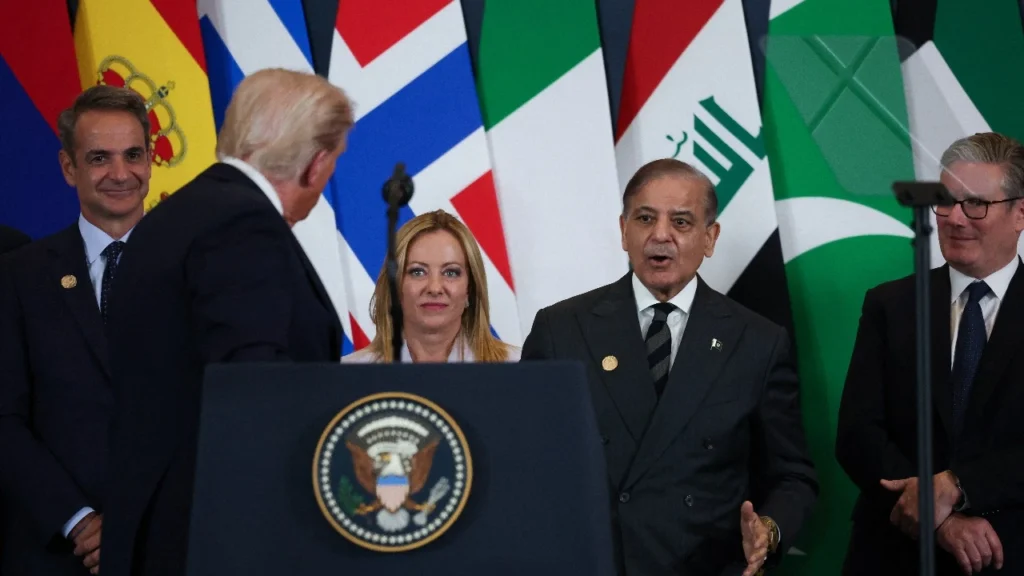
At the global Gaza Peace Summit in Sharm el-Sheikh, Egypt, U.S. President Donald Trump delivered remarks that grabbed immediate attention far beyond the Middle East peace agenda. While speaking on regional stability, he singled out India for praise and directly gestured toward Pakistan’s Prime Minister Shehbaz Sharif, who stood behind him—an act interpreted by many as symbolic and deliberate.
In words that resonated with both diplomacy and drama, Trump said,
“India is a great country with a very good friend of mine at the top—and he’s done a fantastic job. I think that Pakistan and India are going to live very nicely together.”
Then, turning his glance and gesture to Sharif:
“He’s going to help make that happen, right?”
Sharif, according to reports, responded with a smile and a nod—perhaps caught off guard but participating in the moment.
2. What Was Said & Its Implications
2.1 Trump’s Compliment to Modi
By calling Modi a “very good friend” and praising his leadership, Trump reinforced a narrative of closeness with Indian leadership—something he has alluded to in past remarks too.
This public complement in a multilateral setting adds a layer of soft diplomacy; it suggests the U.S. values its relationship with India and seeks to affirm that in front of global peers.
2.2 The Gesture to Shehbaz Sharif
Turning toward Sharif was not just a physical movement—it was diplomatically loaded. It projected the message that the U.S. expects Pakistan to play a role in bridging tensions, especially in South Asia.
The timing—amid a summit focused on peace, ceasefires, and conflict resolution—amplified its symbolic weight.
2.3 Sharif’s Response & Claims
After Trump’s cue, Sharif addressed the summit, lauding Trump’s intervention:
- He credited Trump with helping prevent a nuclear escalation between India and Pakistan.
- Sharif also signaled his government’s intent to nominate Trump for the Nobel Peace Prize, citing his diplomatic efforts in the region.
3. Broader Context & Reactions
3.1 India’s Official Stance
India’s official position holds that the ceasefire and hostilities suspension between India and Pakistan were outcomes of direct talks between their respective military commands, not external mediation.
While Trump has repeatedly claimed he brokered peace in past conflicts, New Delhi has been cautious to clarify that bilateral mechanisms led to the ceasefire in May 2025.
3.2 Symbolism vs Substance
Gestural diplomacy often sends strong signals. In this case:
- It underscores U.S. interest in positioning itself as a regional mediator and influencer.
- It places public pressure on Pakistan to engage positively with India.
- It reaffirms India’s strategic importance in U.S. foreign policy narratives.
But diplomats know: words and gestures must be backed by policy, follow-through, and consistency.
4. Possible Future Dynamics
- Pakistan-India Relations: If this moment is more than symbolism, we might see overtures or diplomatic engagement initiatives between Islamabad and New Delhi.
- U.S. Role in South Asia: The U.S. may increasingly position itself as an arbiter or bridge figure in regional conflicts.
- Domestic Political Narratives: Leaders in both India and Pakistan could interpret this as validation or challenge in their internal political positioning.
#Modi #Trump #ShehbazSharif #Diplomacy #IndiaPakistan #ForeignPolicy #GazaSummit #PeaceTalks