US Imposes 50% Tariff on Indian Exports Over Russian Oil
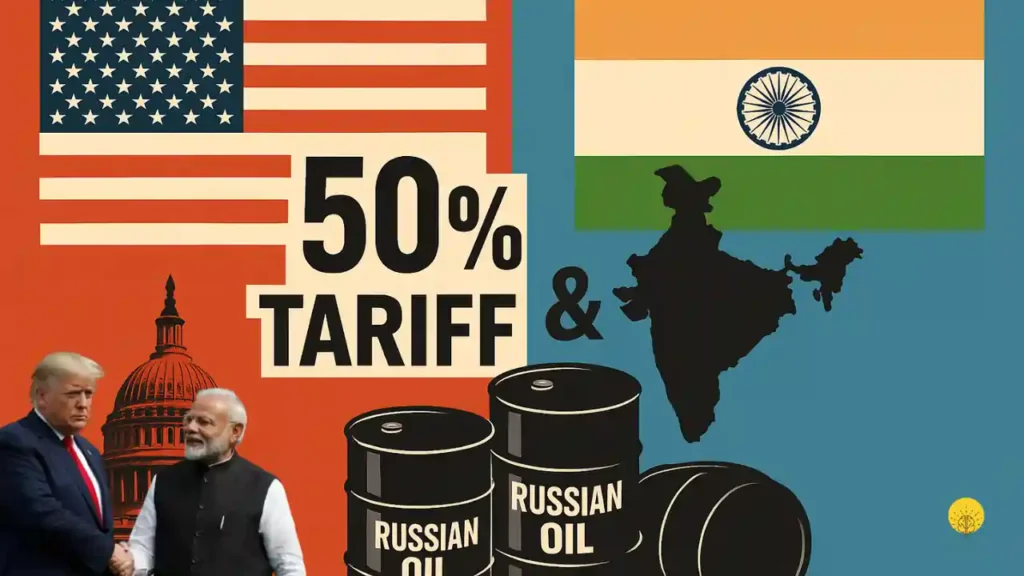
In a major escalation of trade tensions, the United States has imposed a 50% tariff on a wide range of Indian exports. The decision, announced by President Donald Trump, links the punitive duty directly to India’s ongoing purchases of Russian oil. India Today+3Al Jazeera+3mint+3
What’s Behind the Tariff Hike
- On August 6, 2025, Trump signed an executive order to impose an additional 25% tariff on Indian goods, citing national security concerns tied to India’s Russian oil imports. India Today+1
- This is in addition to an earlier 25% tariff announced earlier, bringing the combined rate to 50% for most Indian exports. The Guardian+2The Times of India+2
- The U.S. has framed this move as part of a broader strategy to penalize countries that are “directly or indirectly” aiding Russia’s war effort via energy trade. Al Jazeera+2India Today+2
Economic Impact on India
- Analysts warn that such steep tariffs could sharply reduce Indian exports to the U.S., particularly hitting labour-intensive sectors like textiles, gems, jewellery, leather, and more. The Economic Times+1
- There is a risk of a GDP hit: analysts estimate the tariff could shave off up to 1% of India’s GDP if export decline is sustained. The Economic Times+1
- The move could also make Indian goods uncompetitive in the U.S., pushing exporters to rethink their market strategies. The Times of India
India’s Reaction
- Indian officials have strongly criticized the tariffs, calling them “unfair, unjustified and unreasonable.” Al Jazeera
- India insists its oil imports are driven by market considerations and that energy security must be balanced against geopolitical pressure. Al Jazeera+1
- There is increasing talk in India of diversifying export markets away from the U.S. to reduce the risk of such punitive tariffs in future.
Broader Geopolitical Significance
- The tariff move underlines how energy policy and trade policy are increasingly interlinked, especially in a geopolitically tense era.
- This action could push India closer to other markets, deepening ties with nations less aligned with Western sanctions — potentially reshaping its trade dynamics.
- It further complicates the U.S.-India bilateral relationship, which had been improving on many fronts, including defense and investment.
What to Watch Going Forward
- Whether India launches any formal trade dispute (WTO or bilateral) in response.
- How Indian exporters adjust — by shifting to new markets, reducing costs, or changing product mix.
- If India reduces its Russian oil imports to ease the tariff burden (though politically and economically, that’s not simple).
- Long-term macro impact: how this affects India’s GDP growth, currency, and export-led industries.
- Whether the U.S. revisits or modifies this tariff in future negotiations or as part of broader trade talks.
Take-Away for Savanka News Readers
- For business readers, this is a major risk factor for export-driven industries.
- For policy watchers, this shows how energy dependence can translate into trade vulnerability.
- For general audiences, it emphasizes that global geopolitics increasingly influence even everyday products made in India — things like textiles or leather might now be more expensive to export.
View other news on Savanka News.