
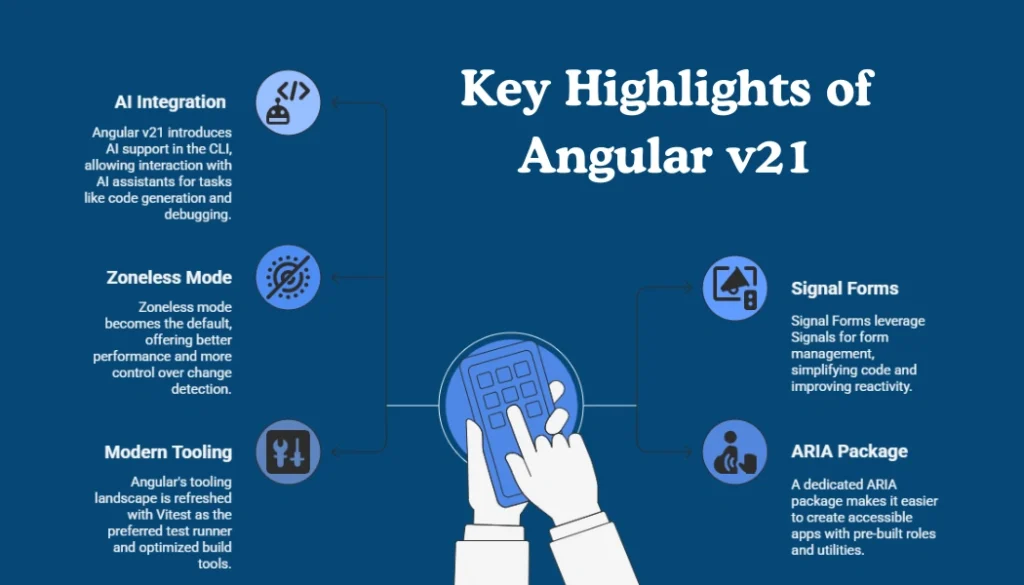
For developers working with Angular, the next major release is always relevant for planning upgrades, new projects and keeping skills current. Angular version 21 (v21) is on the horizon — this blog covers the official release schedule, key features, upgrade advice, and what to watch out for.
Release Date & Support
- According to the official Angular release schedule, version 21.0 is slated for the week of November 17, 2025. Medium+3Angular+3Angular+3
- Support policy: Major releases are supported for ~18 months: around 6 months active updates, then ~12 months of LTS. Angular
- For planning: If your project is on Angular 20 or earlier, you’ll want to make sure you’re ready to upgrade before your version hits the end of active support.
What’s New in Angular 21
Here are some of the standout features and improvements:
- Signal-based forms and improved reactivity: The next gen of form management, aligning with the “signals” API model. devmio – Software Know-How+1
- HttpClient is now included by default: Simplifies setup, no need to manually import the module in many cases. DEV Community
- Continued performance, tooling & SSR/Hydration improvements: Angular is focusing on developer productivity, faster builds, and better server-side rendering support. Medium
- Enhanced routing and modularization: Better incremental loading, route-level render strategies and more modular architecture. Angular
Why It Matters
- For enterprise applications: Angular already has strong usage in large scale, structured apps. These improvements help maintainable codebases, faster builds, and modern feature support. Hygraph+1
- For new projects: If you’re starting fresh, you’ll want to use a version compatible with the upcoming release so you’re not stuck on legacy features.
- For upgrade planning: Knowing the date and support window helps you map out when to upgrade, when to freeze features, and when to migrate custom code.
Upgrade Strategy
Here are some steps you should consider:
- Audit your current version: If you’re on Angular 19 or earlier, you’ll have more major jumps to cover.
- Check dependencies: Third-party libraries, tooling, and custom modules may need updates for v21 compatibility.
- Use the Angular update guide: Angular’s official site offers step-by-step instructions.
- Test thoroughly: Especially around forms and routing changes – the new signals/forms changes may require refactoring.
- Plan downtime or staging: For production apps, ensure you have staging and backup before major version upgrades.
Key Takeaways
- Angular 21 is expected around mid-November 2025.
- It introduces meaningful productivity and architectural improvements (signals/forms, built-in HttpClient, SSR enhancements).
- Upgrade planning is important — especially for production apps.
- If you’re starting a new project now, consider if you should wait for v21 or build with v20 and plan for a smooth migration.

Pingback: Angular 21 Zoneless Mode: Faster Change Detection
It will release on November 20, 2025.